

If you build, spec, or supply Nauta mixers, the drive is the one component you can’t afford to get wrong. Get it right and the machine runs quietly for years. Get it wrong and you’re looking at overheating motors, stalled screws, and a customer complaint that lands on your desk six months after the machine shipped.
This guide walks through how a Nauta mixer drive actually works, how to size one correctly, and what to check before you place an order. It’s written for the people who make that call: OEM design engineers, purchase managers, and dealers.
A Nauta mixer is a batch mixer built for free flowing powders and pastes, known for gentle, low intensity mixing. That makes it the right choice for delicate materials and processes where you can’t afford to damage the product while blending it.
The design is simple and effective: a conical vessel with a vertical screw inside. The screw does two things at once. It turns on its own axis, lifting material upward in a spiral, and it orbits around the inside wall of the cone, pulling material away from the wall and pushing it toward the centre. Material lifted by the screw then falls back down under gravity, mixing thoroughly with the material still being carried upward. Three actions, one gentle result.
You’ll find Nauta mixers running in food powder processing, adhesives, agricultural feed supplements, pesticides and herbicides, plastic resin drying, pharmaceuticals, fertilizers, pet food, spices, talcum powder, and toothpaste production. Different products, same core need: consistent mixing without breaking down particle structure.
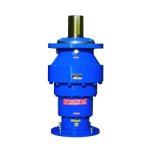
The drive is what turns the screw and swings the arm. A Nauta mixer drive combines a planetary gearbox with a helical gear stage and an electric motor. The motor supplies rotary power, and the gearbox reduces speed while stepping up torque to the level the mixer actually needs.
A typical dual motor Nauta drive includes:
As the name suggests, it runs on two motors, not one. One motor drives the screw, the part doing the actual mixing work. The other drives the swing arm, which carries the screw around the inside of the cone. The two run at very different speeds and very different torque levels, which is why they need separate drives instead of one shared motor.
Here’s a general reference for working volume against screw and swing arm speed and motor power. Treat this as a starting point, not a final spec. Your actual material and process conditions will move these numbers.
| Working Volume (L) | Screw RPM | Swing Arm RPM | Screw Motor (HP) | Swing Arm Motor (HP) |
|---|---|---|---|---|
| 500 | 60 | 1.5 | 5 | 1 |
| 750 | 60 | 1 | 7.5 | 1.5 |
| 1,000 | 60 | 1 | 7.5 | 1.5 |
| 1,500 | 60 | 1 | 10 | 2 |
| 2,000 | 60 | 1 | 10 | 2 |
These figures are a guide only. Always confirm the final rating against your specific material and duty cycle.
Nauta mixers are almost always mounted vertically, either directly on the floor or on a fabricated support structure, depending on your process layout.
This is the part that gets skipped most often, and it’s the reason drives fail early or run underpowered. Sizing a Nauta drive isn’t just picking a motor with enough HP. You need to work backward from the actual load.
What you need to know before you calculate anything:
Step 1. Find the output torque:
T = (HP × 5252) ÷ (Output RPM × Efficiency)
Use an efficiency figure of around 95% for a planetary and helical combination.
Step 2. Work backward to confirm required motor HP:
HP = (T × Output RPM) ÷ (5252 × Efficiency)
Step 3. Apply a service factor.
Multiply the base power figure by 1.5 to 2.0 to account for heavy starting loads and changes in material viscosity during the batch. Skip this step and the drive will be sized exactly to the load with zero margin. The first thick batch or the first cold start will push it past its limit.
Screw drive and swing arm drive are sized separately. Don’t average them or size one motor to cover both. The screw motor typically needs 5 to 10 HP depending on batch mass and how much resistance the product offers. The swing arm motor needs far less, usually 1 to 2 HP, because it’s guiding the arm’s path rather than shearing through bulk material.
Gearbox ratio typically falls between 25:1 and 1,440:1, depending on how far you need to step down a standard 1,440 RPM motor to reach your target screw and arm speeds.

If you’re a purchase manager or an OEM design engineer, this is the checklist to run through before the PO goes out. Every item here has caused a wrong drive selection at some point:
Any one of these left unconfirmed at quotation stage is where a wrong sized drive usually starts.
Most drive selection problems trace back to details that were never confirmed up front:
Any single one of these can shorten the life of a drive. A few of them together usually means a service call within the first year.
Price matters, but it’s rarely the deciding factor once a purchase manager has been burned by a drive that failed early. For Nauta mixer manufacturers, machine builders, and OEM buyers, the supplier relationship needs to cover more ground than a quotation:
As a Nauta Mixer manufacturer in India, Precision Gear Transmissions builds dual motor drives specifically for this application, not a generic gearbox relabelled for mixing duty.
What’s the difference between the screw drive and the swing arm drive?
The screw drive turns the mixing screw on its own axis and typically needs 5 to 10 HP depending on batch size and material resistance. The swing arm drive rotates the screw’s orbit around the cone and needs far less power, usually 1 to 2 HP, since it’s guiding the path rather than shearing material.
Why does a Nauta mixer need two separate motors instead of one?
The screw and the swing arm run at very different speeds and torque levels. The screw runs at 60 to 120 RPM, the arm at 1 to 2 RPM. A single shared drive can’t serve both requirements efficiently, so each gets its own motor and reduction.
What gearbox ratio does a Nauta mixer drive typically need?
It depends on your target screw and arm speed, but ratios generally range from 25:1 up to 1,440:1 to bring a standard 1,440 RPM motor down to the slow, high torque speeds a Nauta mixer needs.
Can the drive be customized for OEM branding?
Yes. Nameplate and branding customization is available for OEMs and machine builders who want the drive to carry their own identity on the finished machine.
What service factor should I apply?
1.5 to 2.0 over the base calculated power, to cover heavy starting loads and viscosity changes during the batch. The exact figure depends on your material and duty cycle, so confirm it with your drive manufacturer rather than assuming a default.
A Nauta mixer is only as reliable as the drive behind it. If you’re specifying a new machine, sourcing for an OEM, or replacing a drive that’s underperforming, send us your working volume, target RPM, and material bulk density. Our engineering team will size the drive and quote it directly.
Talk to us about your Nauta Mixer drive requirement today.
WhatsApp us